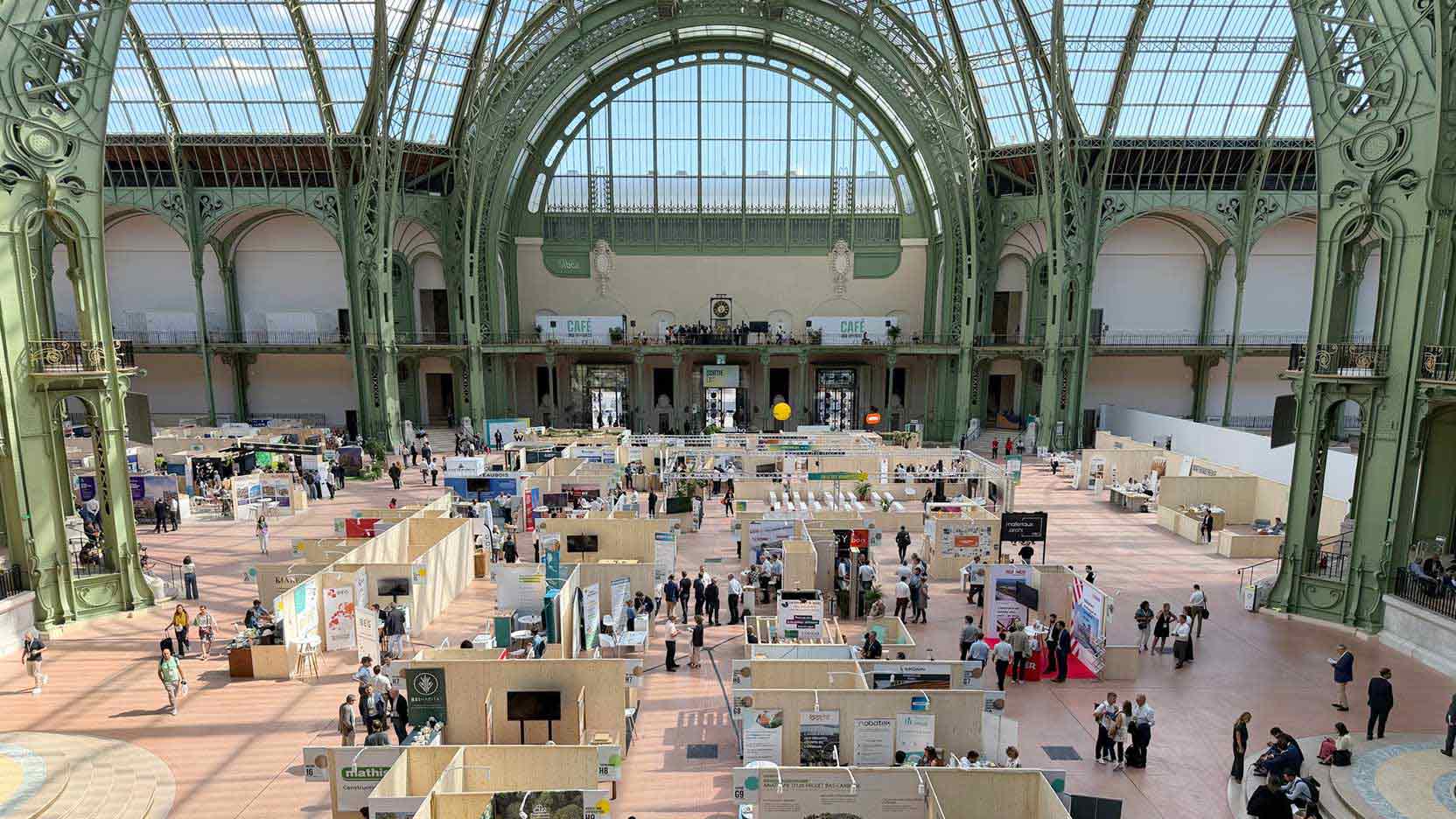
From 1 to 3 September, SIBCA 2026 brought real estate professionals together at the Grand Palais to explore ways to accelerate the sector’s decarbonisation. GA Smart Building was a partner of this fifth edition!
SIBCA 2026 brought the industry together to advance low-carbon real estate
Developers, investors, clients, architects, manufacturers, local authorities and occupiers gathered to compare experiences and share solutions to the sector’s environmental challenges.
At the opening of the event, Élodie Le Breton, GA Smart Building’s Director of Sustainability Strategy, joined the panel discussion “The role of off-site construction in upgrading existing office buildings”. Céline Beaujolin, Executive Director of Filière Hors-Site France, moderated the discussion, which also featured Vincent Ginguenau (Icade), Emeric Fagnot (Gecina), Olivier Louvet (Groupe Goyer), Élodie Macé (CSTB), Patrick Miton (Soho Architecture), Clément Vergely (Vergely Architectes) and Olivier Tardieu (Redman). Élodie then took part in the presentation of Business Immo’s Low-Carbon Barometer, alongside Nathalie Bardin (Altarea), Gaël Thomas (Business Immo) and Vincent Bes (Wicona France).
The discussions highlighted how much the debate has evolved. Carbon now affects asset value and long-term viability, extending its significance beyond environmental considerations.
Élodie also emphasised the need to accelerate innovation so that proven solutions can be industrialised and deployed at scale, making low-carbon development a market standard.
SIBCA also made room for a more playful format. David Bruchon, Managing Director of GA Smart Building, took part in the first edition of “Questions pour une transformation de marché”, devised by Action for Market Transformation (A4MT). Inspired by the popular French television quiz, the event tested participants’ knowledge of changes in real estate, taking the subject seriously while keeping the format light-hearted. Competing against Odile Batsère (Société de la Tour Eiffel), Léa Glin (Groupe Pierreval) and Rodolphe Deborre (Rabot Dutilleul), David won this inaugural edition!
Scaling up off-site construction requires new practices
Wider adoption of off-site construction raises questions about the conditions needed to integrate it into more property developments.
During the panel discussion “Property development and off-site construction: what new procurement models?”, moderated by journalist Julie-Anne Millet, Kader Guettou, GA Smart Building’s Managing Director for Commercial Property and Public Facilities, exchanged views with Marjolaine Bichet (Bertin Bichet Architectes), François Correia (Care Promotion) and Hervé Demeure (Continental Foncier).
For Kader, off-site construction changes the value chain and the way buildings are procured. It moves procurement from a project-based approach, with its uncertainties and potential overruns, towards a product-based approach backed by guaranteed commitments. For this model to work, manufacturers must be involved at the earliest design stages so they can optimise the project from the outset.
Sébastien Matty, Chairman of GA Smart Building, also championed off-site construction in an interview with BiTV / CoStar News. He sees it as a practical way to build better, reduce carbon emissions and transform the industry. He called for the wider deployment of industrialised solutions, which he considers essential to France’s competitiveness and economic sovereignty.
Off-site construction helps transform existing buildings
SIBCA 2026 also addressed a major challenge facing the sector: what should be done with existing properties, particularly vacant commercial buildings?
During the panel discussion “Off-site construction for the conversion of vacant commercial buildings”, moderated by journalist Stéphane Miget, Yannick Sola, Managing Director of Ossabois, a GA Smart Building subsidiary, joined Jérôme Balas (Groupe Balas), Jérôme Lahure (Arkeo Système), Marine May (Techniwood) and Patrick Rubin (Canal Architecture). He explained how industrialised construction can support the transformation of existing assets, provided off-site methods are integrated early enough in the design process to help make the project financially viable.
The conversion of the former National Road Information Centre (CNIR), known as “Bison Futé”, in Rosny-sous-Bois provides a concrete example. The project refurbishes and extends the existing building using timber components manufactured off-site, including 79 3D timber modules. Early design work makes it possible to shorten the construction schedule by a third.
Starting with the existing building to determine the most suitable solutions was also the focus of Sophie Meynet’s contribution. GA Smart Building’s Managing Director for Residential Property joined Gabriel Franc of Agence Franc at the conference “Low carbon: building differently, starting today” to discuss Rooj-Lumière in Chatou.
This office-to-residential conversion retains the entire existing structure. The project then combines construction methods according to their suitability, including off-site prefabrication and reuse. This approach improves control over construction and reduces disruption within a constrained urban setting.
Collective initiatives accelerate the sector’s transformation
The Réseau Hors-Site brings the industry together to build and renovate differently
The ambition to organise the industry took shape with the creation of “Réseau Hors-Site, ensemble pour construire et réhabiliter autrement”, an alliance led by ACIM, Filière Hors-Site France and Campus HORS SITE. It brings together more than 200 organisations from the off-site and modular construction ecosystem. The initiative aims to strengthen coordination across the industry and support the growth of off-site construction.
“Demain tous hors-site” promotes wider adoption across the value chain
SIBCA 2026 also marked the launch of “Demain tous hors-site”, a movement led by the Convention des Entreprises pour le Climat (CEC) and Filière Hors-Site France, with support from Groupe Balas and GA Smart Building.
The movement aims to turn off-site construction from a specialist subject into an appealing new standard embraced across the value chain. It builds on the CEC’s commitment to a regenerative economy, in which off-site construction enables a different approach to production, using fewer resources to create buildings designed to last and adapt.
By bringing together organisations ready to commit to this approach, “Demain tous hors-site” seeks to make off-site construction a shared endeavour across the industry.